

Leadership Development Is Not Leadership Management
Category : Leadership
Many organizations say they are investing in leadership. But when you look closer, they usually mean leadership development: training, coaching, workshops, and other ways to build the skills of individual managers or high-potential employees.
That matters. But it is not enough.
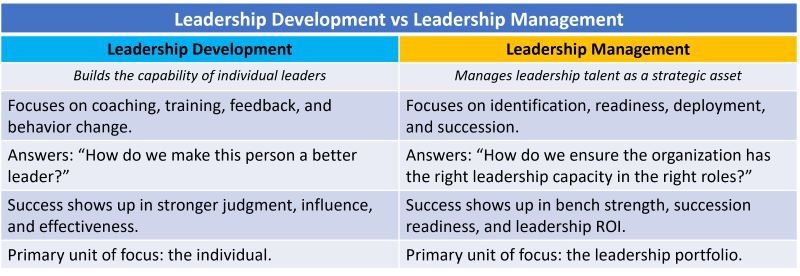
If leadership development builds the leader, leadership management builds the system.
Leadership management is the organizational discipline of identifying, developing, and deploying leadership talent with the same rigor used to manage any high-value asset. It is not a course catalog. It is not a one-time retreat. It is not a performance review with a new name.
It is a business strategy.
Why the Difference Matters
Too often, organizations treat leadership as if it will emerge naturally from promotions, experience, or personality. The result is predictable: uneven bench strength, succession gaps, inconsistent readiness, and leaders placed into critical roles before they are truly prepared.
Leadership development addresses one person at a time.
Leadership management asks a different question: Do we have the right leadership capacity, in the right places, at the right time, to execute the strategy?
That is a much bigger question, and it is the one that matters most.
Leadership Development Builds Capability
Leadership development is essential. It helps people become better communicators, decision-makers, coaches, and team builders. It strengthens self-awareness, emotional intelligence, judgment, and influence.
In short, it improves the individual.
A strong leadership development approach can accelerate growth and improve performance. But even the best development effort will fall short if the organization has no system for identifying which leaders matter most, where they are needed, what readiness looks like, and how they should be deployed.
Development alone builds potential.
Leadership Management Creates Leverage
Leadership management is where organizational strategy becomes tangible. It includes:
- Identifying high-potential leadership talent early.
- Assessing readiness for current and future roles.
- Building a deliberate succession pipeline.
- Deploying leaders where they create the most value.
- Tracking leadership capacity as a measurable enterprise asset.
This is the difference between hoping you have the right leadership talent and knowing you do.
The most effective organizations do not leave leadership talent to chance. They manage it with visibility, discipline, and intent. They treat leadership as a resource that can be developed, deployed, and strengthened over time.
That is what Leadership Resources Management is really about.
The Strategic Shift
If your organization wants better leadership outcomes, the conversation cannot stop at training.
It must move toward questions like:
- Which leadership roles are business-critical?
- Who is ready now, who is ready soon, or who needs more development?
- Where is our leadership bench strong, and where are the gaps?
- Are we developing leaders in alignment with current or future business needs?
- Are we deploying talent in a way that maximizes organizational value?
These are not HR-only questions. They are enterprise questions.
Senior leadership should care because leadership management affects continuity, execution, culture, and growth. It reduces risk and improves the odds that strategy will actually be implemented well.
Final Thoughts
Leadership development builds stronger people. Leadership management builds stronger organizations.
If you want leaders who can perform better today, invest in development.
If you want an organization that can consistently produce, place, and sustain leadership talent for the future, build a leadership management system, like Leadership Resources Management.
If leadership development is the growth engine, leadership management is the operating system. One builds capability; the other ensures that capability is strategically identified, developed, and deployed where it creates the greatest organizational value. That is the shift from leadership as a program to leadership as a strategic asset.
Our Leadership Resources Management solution helps organizations build stronger leadership management strategies with a data-informed, unbiased and proven approach. It is designed to improve leader alignment, increase retention of high-value leaders, and reduce the risk of toxic or imbalanced leadership situations.
If this is a priority for your organization, I’d welcome a conversation. Schedule a 30-minute executive briefing, and we can explore whether a pilot study makes sense for your team.