
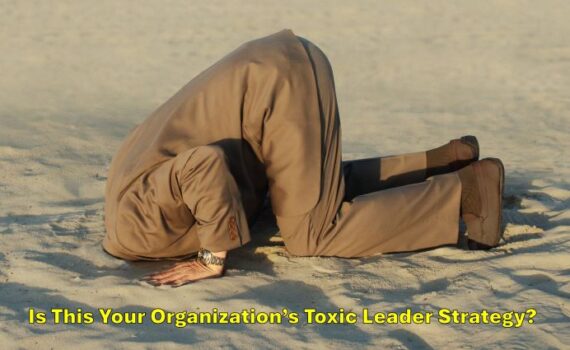
Ignoring Toxic Leaders Is Not a Sustainable Strategy
Category : Leadership
Have You Ever Worked for A Toxic Leader?
Many people have a story they will never forget. Some are still living it right now.
I remember a toxic leader I once worked for. This person checked every box of what I now understand defines a toxic leader.
- They publicly criticized people on the team.
- They showed almost no empathy for anyone but themselves.
- They micromanaged every decision anyone on the team made.
At one point, this person asked me to convince someone on my staff to retire early because they saw him as “deadweight.” I refused. He had been with the company for 40 years and was only one year away from full retirement with a pension. He was also a well of institutional and industry knowledge.
Looking back, I realize the entire organization was toxic. I still remember a conversation with the company president who knew about this person’s behavior but continued to support them because they would “sell their mother to get ahead.” That told me everything I needed to know about the culture.
Fast Forward to Today
Today, I fully understand what toxic leadership looks like. My research has shown me how common it really is, and I have come to the conclusion that every organization has at least one toxic leader. The larger the organization, the more likely it is that there are several.
Some industries see even higher levels of toxic leadership, including manufacturing, healthcare, higher education, and technology. Even senior leaders at organizations that regularly appear on “great place to work” lists acknowledge they have toxic leaders in their ranks.
Here is the hard truth: senior leaders often choose to ignore them, especially if those leaders are considered high performers. No one wants disruption in the business or a gap in a critical role. What they fail to account for is the disruption and personal toll toxic leaders impose through reduced productivity, higher turnover, legal exposure, and reputational risk.
The Financial Hit You Do Not See on the P&L
The financial impact of toxic leaders is significant. Various studies show just how expensive these leaders can be.
One estimate puts the cost of a mid-level toxic leader at two to five times their annual salary. For someone earning $90,000 per year, that is an annual drag of $180,000 to $450,000.
For clearly toxic but highly valued “rock stars,” the damage climbs to five to ten times their annual salary. At a $200,000 salary, that can mean more than $1 million per year in damage from a single toxic leader.
Now apply that to a 1,000-employee organization with 20 percent of employees in leadership roles, which is roughly 200 leaders. If only 10 percent of them are toxic, the cost can range from $5 million to $15 million every year, calculated using our Financial Impact Calculator.
That is the hidden “tax” toxic leaders charge your culture and your bottom line.
Why Organizations Still Hesitate to Act
Most organizations already know who their toxic leaders are. They are not a mystery.
The hesitation to act usually comes from two places:
- Many toxic leaders also deliver strong short-term performance.
- Senior leaders worry about legal exposure or disruption if they move too quickly or without data.
They often assume termination is the only option. In reality, that is not always the case. Some toxic leaders can be reformed with the right coaching, clear expectations, and accountability.
A Data Driven Way to Deal with Toxic Leaders
The best way to start is to identify toxic leaders using a proven, quantitative, and completely anonymous leadership assessment tool.
Here is how that works:
- The individual leader completes a comprehensive self-assessment of their leadership behaviors.
- Their team, including peers, direct reports, and their supervisor, assesses their perception of that leader’s observable behaviors.
- The process generates a robust dataset for analysis and comparison, with minimum participant thresholds to reduce the risk of retaliation.
Once the analysis is complete, conversations with the leader and their supervisor help determine the best path forward. In some cases, the leader can be reformed through targeted coaching and development. In other cases, they may need to be counseled out of the organization.
The key is this: you are no longer making a gut decision. You are acting on evidence.
Your Next Step
If you suspect you have toxic leaders in your organization, you probably do. The real question is how much damage they are doing and how long you can afford to ignore it.
To learn more information on how we help organizations use data to address their toxic leader issues, please visit, “Revealing Toxic Leaders Before They Damage Your Culture”, on our website. While there, review the case study on how we identified 2 toxic leaders in a team of 15 senior leaders. Then schedule a 30-minute Executive Briefing to discuss how a toxic leader discovery project could work for your organization.